

Demand is growing faster than ever
Transit agencies across the country are facing the same challenge: demand for service is growing faster than the resources available to deliver it.
In 2024, public transit agencies delivered 7.7 billion passenger trips, up nearly 500 million from the year before. Demand-response services have recovered to 93% of pre-pandemic ridership, the strongest recovery of any mode. And the need isn't slowing down. As populations age, more riders will depend on flexible, demand-responsive service.
Demand is only one side of the equation. Agencies are also managing workforce shortages, rising operating costs, and growing pressure to deliver reliable, real-time service. Roughly one in three transit positions is hard to fill, adding strain to teams that are already stretched.
None of that changes what riders expect. Reliable service. Accurate information. Arriving on time.
Meanwhile, your teams are coordinating thousands of trips, hundreds of vehicles, changing traffic, disruptions, maintenance issues, and rider needs — often across systems that were never designed to work together.
"The central challenge is no longer just growing ridership. It's growing capacity, without a matching rise in staff, budget, or complexity."
The hidden cost of disconnected operations
For decades, agencies invested in software to solve specific challenges.
While each solution addressed a specific need and added value, their combined effect introduced a new obstacle: information silos.
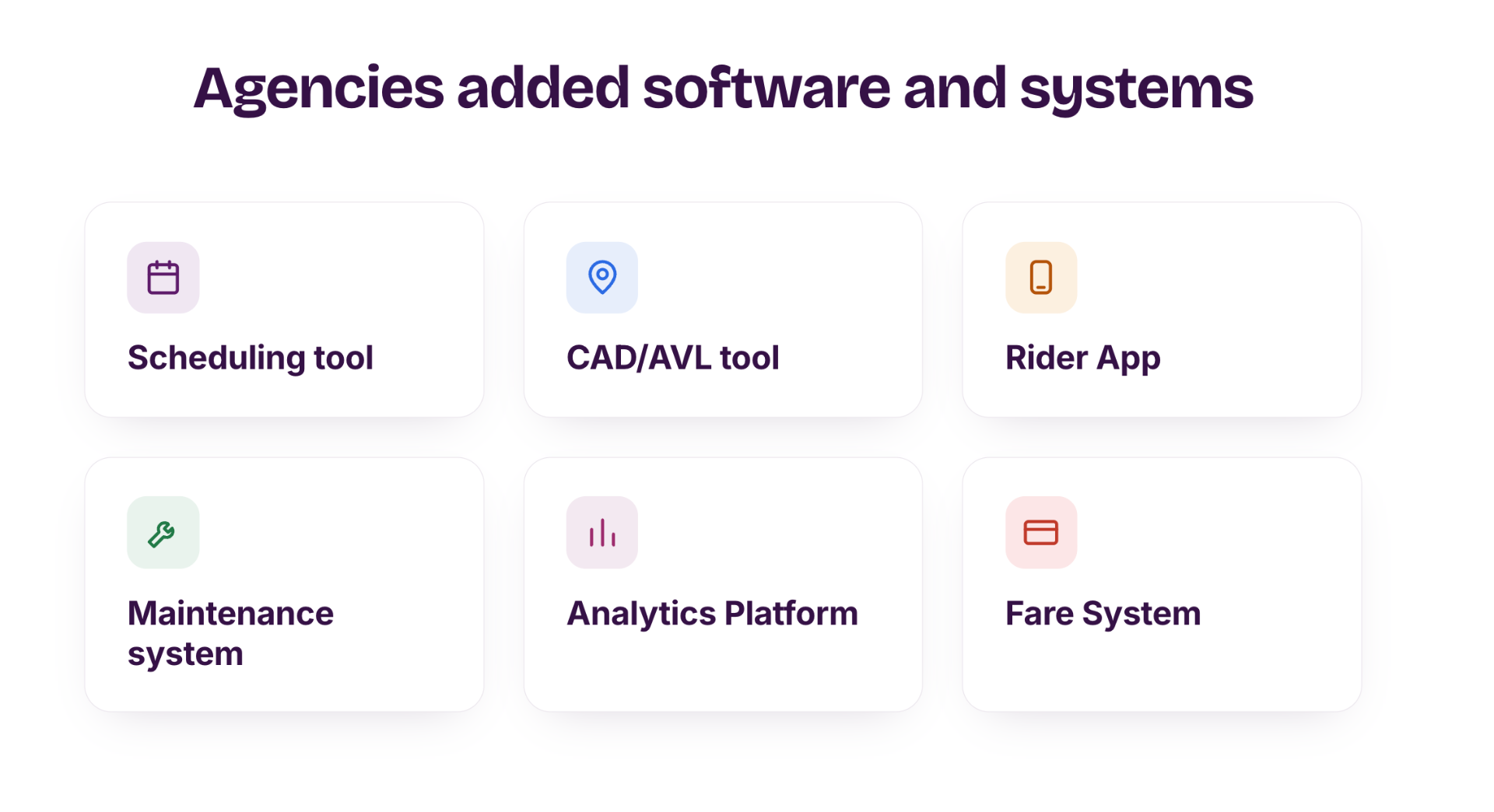
Transit teams found themselves increasingly bogged down by the need to coordinate between these disparate tools. To manage the flow of data, they relied on:
- Constant phone calls
- Endless spreadsheets
- Manual updates
- Inefficient workarounds
People became the integration layer. Not by choice, but because the software was never designed to work as one system.
The result is that staff spend more time moving information than making decisions. The problem isn't missing technology. It's technology that doesn't talk to itself.
Connected operations create capacity
A transit agency is one network, not a set of separate services. A maintenance issue affects operations. Operations affect riders. Riders call dispatch. The real challenge is making information move through the organization as fast as vehicles move through the city.
That's what connected operations deliver. When something changes anywhere in the network, everyone works from the same information, and the right update reaches the right team.
One morning, two outcomes
A rider books a paratransit trip. During the morning pre-trip inspection, the wheelchair lift on Vehicle 1083, assigned to Line 14, is cycling slowly and gets flagged.
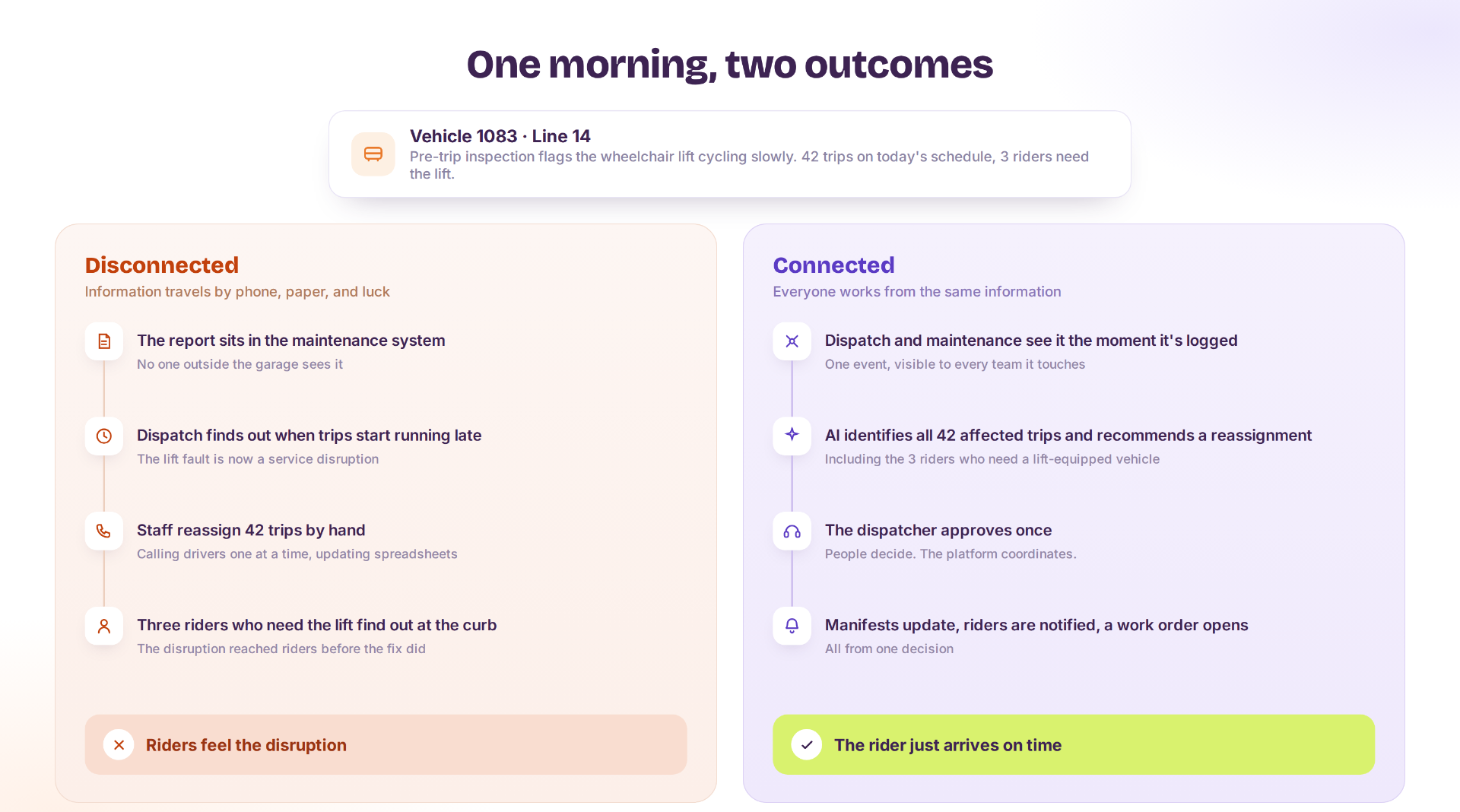
The ripple effect
That single approval triggers a coordinated response across the network:
- Driver manifests update on both vehicles
- Riders get accurate pickup times by app, SMS, or AI Voice
- A maintenance work order opens with the inspection notes attached
- Planning sees the pattern later, before it becomes the next disruption
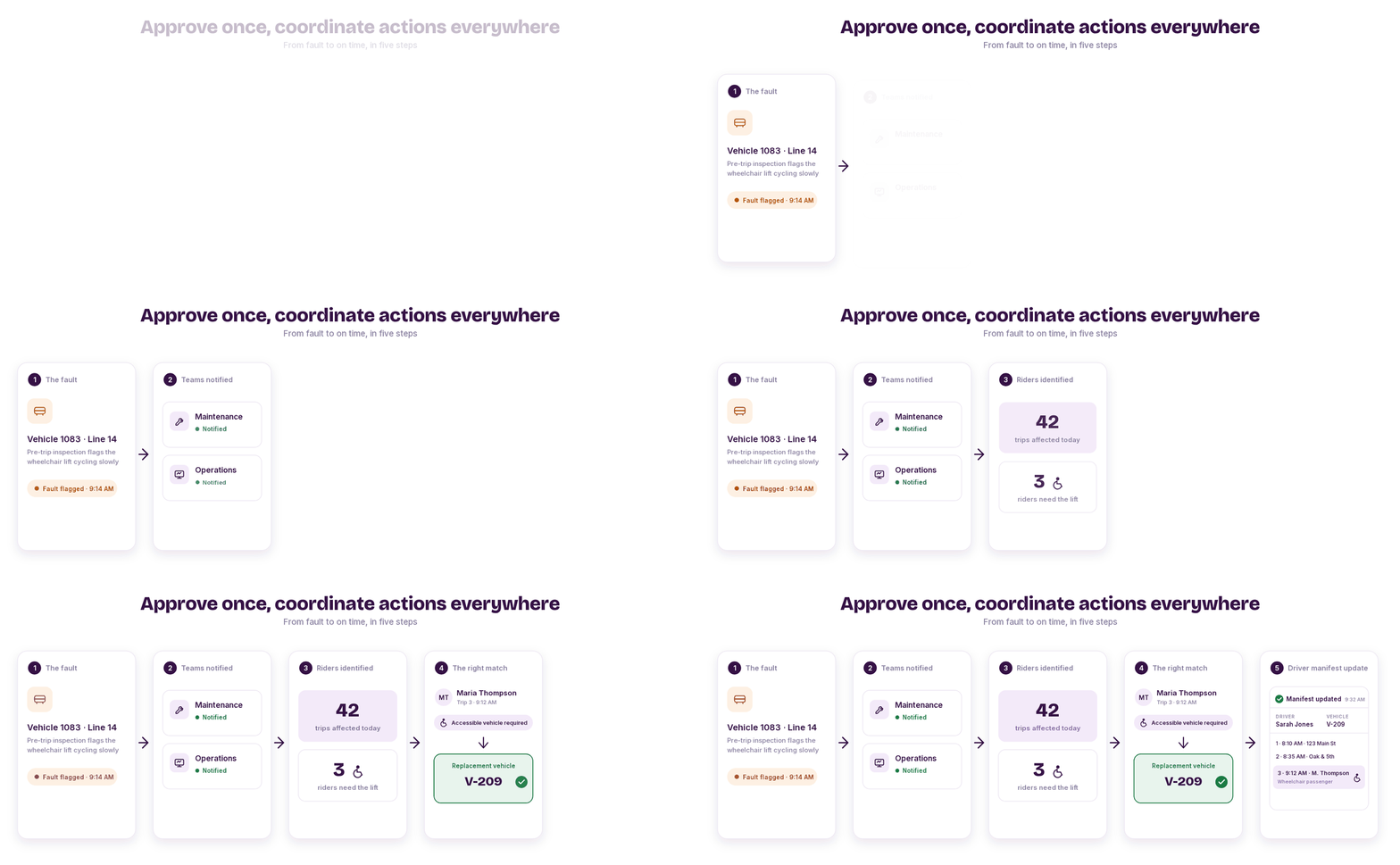
The rider just arrives on time, never knowing what was resolved on their behalf. The same principle holds for detours, traffic, and weather: approve once, coordinate actions everywhere.
A new operating model for transit
The next decade presents a simple reality for transit agencies: demand will continue to grow faster than resources. More riders. More complexity. Higher expectations. But not necessarily more staff, more budget, or more time.
The agencies that succeed won't be the ones that avoid complexity. They'll be the ones that absorb it.
For decades, transit organizations have added tools to manage growing demands. The next evolution isn't adding more software. It's creating a connected operation where information moves as quickly as the service itself.
That's why connected operations matter. And it's why AI matters. Connected operations create visibility across the entire network. AI helps teams understand, anticipate, and act on what happens within it.
Together, they create something transit needs more than ever: capacity.
"The future of transit won't be defined by disconnected systems working independently. It will be defined by connected operations working as one."
What we're building at Spare
Connected operations create the visibility. AI puts it to work, as practical decision support for the teams you already have. At Spare Connect Live 2026, we laid out a three-phased approach to how this moves from reactive to proactive — and the first phase is already in your hands.
Scout, Spare's AI assistant, rolled out across the full platform at the conference and is available to every Spare user now. Ask it a plain-language question about on-time performance, a specific trip, or a pattern you're seeing in delays. It answers directly. No digging through dashboards, no building a report.
The second phase, proactive monitoring, is next: maintenance flags based on vehicle behavior, rider cases that need follow-up, service issues that are trending before they fully materialize.
The third phase is agentic AI: the system carries out trusted, repeatable workflows so your team can focus on the decisions that need a human. AI Voice is already proving this out, handling 45 to 70% of reservation calls end to end at agencies running it today. That model is coming to more of the platform.
Instead of digging through reports and dashboards, your staff ask in plain language and get a straight answer.
- What was our on-time performance this week?
- Which routes are seeing the most delays?
- What's this rider's trip history?